

Do people with visible disabilities face disclosure decisions? People often assume that if a person’s disability is visible or observable—like an amputated limb or a facial difference—they don’t have to disclose it because it is already obvious. Disclosure was thought to be a hurdle reserved for those with invisible disabilities, like chronic pain or mental health conditions. However, our new research reveals that people with observable disabilities do face disclosure decisions, precisely because their differences are noticeable. Indeed, the information others expect from them is similar to what is expected when those with invisible disabilities disclose

.In a new study, we interviewed 25 people with various observable disabilities—conditions like mobility disability, blindness, limb amputation, deafness, and speech disorders. We found that the context and the nature of the disability influenced the need for disclosure and affected motivations behind it. This interplay impacted how much control individuals felt over their disclosure and the level of detail they provided, ultimately relating to their well-being.
The Myth of the “Obvious”
When someone has a visible disability, they are often denied what scholars call “civil inattention”—the polite disregard we give strangers in public. Instead, they are met with stares, intrusive questions, and assumptions. This forces them into a continuous “mental calculus”—as one of our participants called it—deciding how much of their private medical history they owe to a curious barista or a potential employer.
While a disability might be observable, the cause, consequences, and specific needs associated with it are not. People with observable disabilities are perennially asked: “What happened to you?” This question indicates that people are trying to make causal attributions—they want to know what caused the disability to determine if the disabled person is “at fault” or if they themselves are at risk of a similar fate.
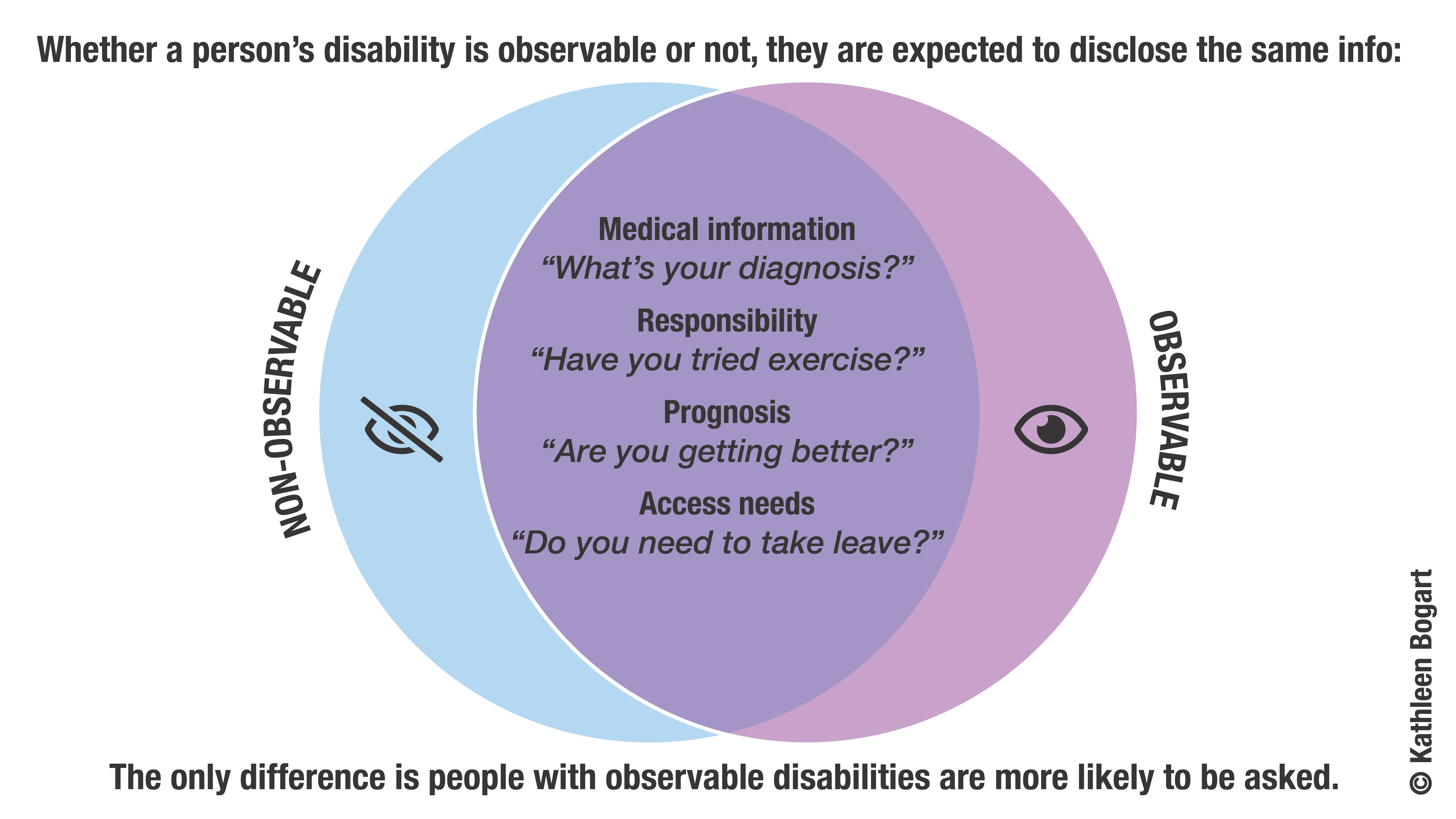
Disclosure almost never entails simply naming the condition. People with observable and non-observable disabilities alike are expected to provide more information. Consider an example of someone disclosing an invisible disability (“I have mental illness”)—a condition more traditionally understood to involve disclosure—compared with someone disclosing a visible disability (“I am a wheelchair user”). Regardless of the disability type, people want to know the same things, including medical information (“What’s your diagnosis?”), responsibility (“Have you tried exercise?”), prognosis (“Are you getting better?”), and access needs (“Do you need to take leave?”). The unique part of observable disability disclosure is that others have already noticed it, which may heighten the expectation to have these questions answered.
Consider one participant who used a leg brace and cane due to cancer. People assumed his leg brace was due to a temporary injury and frequently asked “What did you do?” This placed him in a position where he was expected to disclose deeply private and potentially traumatic information, and if he explained it, it “craters the mood.”
Emphasizing the importance of examining this topic, this participant said, “Nobody prepared me, ‘hey, so here’s the thing about self-disclosures.’ But seeing that people are looking at it [in the current study], I’m like, Oh, yeah, that’s absolutely a thing…This is a real issue, and it’s pervasive.”
Context Matters
Access needs were a primary driver for disclosure. In a world not built for everyone, disabled individuals are often forced to reveal their private medical status simply to do their jobs or attend a meeting.
The setting of an interaction significantly changes this dynamic. For example, a person with a mobility disability might not need to disclose anything on a Zoom call because the environment is naturally accessible. But if they are invited to an in-person meeting, they may have to disclose their disability just to ensure there is a ramp or an elevator.
Even disabilities that are often thought of as highly observable can be rendered invisible by the situation. One participant, who was a wheelchair user, provided a striking example of the influence of situation on observability and disclosure. While she was being treated in a hospital for a condition unrelated to her disability, her wheelchair wasn’t in the room. Her doctor’s questions revealed she didn’t know she was a wheelchair user despite having access to her medical information. Our participant had to tell her doctor: “I can’t stand up and walk to the scale like you want me to.” This story illustrates the power of the situation in affecting whether a disability is visible and the potentially serious consequences of assuming that disabilities are always observable.
Dimensions of Disability
Disability observability exists on a spectrum. Some disabilities, like facial differences or wheelchair use, are almost always visible. Others, such as chronic health conditions or ADHD, often aren’t. Factors surrounding the disability—like whether symptoms are flaring—affect whether others can observe it.
Not all observable disabilities are treated equally. People with “prototypical” disabilities—those commonly represented in our society or media, like blindness or wheelchair use—often find that their needs are better understood by the public.
However, those with “non-prototypical” or rare disabilities—such as speech disorders, facial differences, or multiple complex conditions—face a different challenge. These individuals often feel higher pressure to disclose, having to explain their diagnosis and symptoms in great detail to ensure their needs are met.
The Power of Choice: Autonomous vs. Compelled Disclosure
At the core of this experience is Self-Determination Theory, which suggests that people have three basic psychological needs: autonomy (feeling in control), competence (feeling capable), and relatedness (feeling connected to others).
When a disabled person chooses to share their story on their own terms, we call this autonomous disclosure. People disclosed for various reasons: requesting accommodations, building understanding, or connecting with others. Examples included a professor mentioning their limb difference on the first day of class to remind students that everyone faces obstacles, and a writer blogging about their disability to control the narrative. Autonomous disclosure is linked to those basic psychological needs and is associated with higher self-esteem, a sense of competence, and feelings of belonging.
Participants also exercised their autonomy by choosing not to disclose in certain situations, like when it didn’t feel safe, to maintain privacy, or to signal inappropriate behavior from others.
In contrast, compelled disclosure occurs when someone feels they have no choice but to explain themselves. This happens when people ask prying questions, or—most frequently—when a person must explain their disability just to get access to a building or service. Feeling forced to disclose is often linked to distress, shame, and internalized ableism.
Taking Back Control
Participants highlighted the importance of autonomy in disclosure decisions. They recommended developing decision-making aids like pro-con lists and decision trees about disclosure. Having a prepared response to common questions can help people feel more in control of their privacy boundaries.
While individual strategies are helpful, structural change is the ultimate way to support self-determination. Universal design—environments and policies that are proactively accessible to everyone promote autonomy. When a building is truly accessible, a person doesn’t have to “come out” as disabled just to enter the front door.
Furthermore, society needs to respect privacy boundaries. Just because a disability is visible does not mean the person’s medical history is public property. As one participant said, “It’s harder to set those boundaries when it’s so obvious, because when people can observe something, a lot of people feel like then it’s kind of their right to find out more about it. And that’s not really the case. I’m still a person, and I deserve privacy.”
A version of this article appears in Psychology Today.
I found this piece very informative. As an Autistic person, my disability can be both visible and invisible. Visible when I choose to unmask or am not mentally capable of masking and invisible when I am masked. As such, I have experienced both feeling like I have no choice but to disclose and disclosing out of my own freewill.
I have a name for it now- "compelled disclosure". Thank you! Thank you! A thousand times - Thank you! From someone who is compelled to disclose almost daily.