

I have used various terms over the years to describe whether a disability is evident to others—is it visible or invisible, concealable or not?—yet none of them felt quite right. We often assume these labels are binary, fixed, inherent traits of the disability. This dichotomy doesn’t capture the fluid, multisensory way that disability is experienced and perceived. In our latest article in Social and Personality Psychology Compass, my colleagues Marine Granjon, Pauline Rasset, and I propose a shift. Instead of a binary, we propose the disability observability spectrum.
The Problem with “Visibility”
The most common term we use, “visibility,” is inherently ocularcentric. It prioritizes sight as the only way to perceive difference, which is itself a form of ableism. Disability is lived and recognized through multiple sensory channels. For example, although you may not see a person’s speech disorder, you may hear it when they speak.
The Problem with “Concealability”
Other terms—like concealable and hidden—don’t hinge on sight. However, they can imply that disability should be hidden, or that the person is making a conscious choice to keep it a secret. But not everyone with a concealable disability conceals. Knowing someone has a concealable disability doesn’t tell us if they actually are concealing it. We might consider a person with diabetes to have a concealable disability, but if they have a continuous glucose monitor on their arm and choose to wear a short sleeve shirt, their disability may be observable to others. Concealment is a behavior, not a permanent state of being, and it’s just one part of the equation of whether others observe a disability.
The Problem with the Binary
When we talk about disability as visible or invisible, concealable or non-concealable, we fail to capture the fluid, dynamic way disability may show up in the world. It’s time to move beyond the binary and recognize that observability occurs on a spectrum, fluctuating from day to day, person to person, situation to situation.
The Power of the Verb
Lately, I have been using the term “observable” disability. This language avoids the focus on a singular sense (like visibility), so it accounts for the possibility that disability could be observed in other ways (like sound). It also has a verb form “observed.” The verb form is powerful because it shifts the focus away from the individual and places it squarely on the social interaction. It acknowledges that visibility isn’t an inherent trait you carry; it is a social category that may or may not be observed in a given situation.
What Moves Us Along the Spectrum?
Whether a disability is observed at any point in time depends on a combination of factors within the individual, the observer, and the context.
The Individual: The prototypicality of a disability—that is the extent to which the disability type aligns with public stereotypes about what a disability is—affects whether it is observed. A wheelchair user is the international symbol of disability, appearing on accessible bathroom stalls and parking spaces. Contrasted with a less prototypical disability like facial paralysis, individuals using wheelchairs are more likely to be recognized as disabled.
A disability may not directly affect the person’s appearance but may involve the use of assistive tools or service animals that nonetheless make the disability observable. For example, you probably can’t look at someone and know they have epilepsy most of the time, but if they get a service dog to alert them to seizure activity, their disability would then be observable.
Disability course—whether symptoms change over time—influences observability. Someone with multiple sclerosis may be observed as disabled during a flare when using a scooter, but not when they are walking unaided during remission.
As previously mentioned, concealment is an individual behavior—one factor among many—that affects observability. The person with epilepsy in the earlier example may choose to leave her service dog at home if she wants to conceal her disability.
The Observer: Not all observers notice the same things. Someone with “insider knowledge“—perhaps because they have a disability themselves or know someone who does—might notice subtle cues that others miss. For example, Mary moves from sitting to standing gingerly, minimizing flexion in her back. When standing, she also frequently shifts her weight between positions and leans on objects when possible. Although most people don’t notice, Mona does because this is how her mother moves when her back pain flares.
The Context: Our environment changes everything. Inaccessible spaces make a disability more observable. A wheelchair user’s disability might not be observed during a Zoom job interview, but it becomes observed the moment they arrive for an in-person meeting. The environment affects their access needs and whether they feel the need to disclose their disability.
The Observability Spectrum Influences Ableism Pathways
Where a person falls on the observability spectrum predicts the specific “flavor” of prejudice they are likely to encounter. By integrating this spectrum with key psychology theories, we can map out distinct pathways to ableism: paternalism or delegitimization.

Paternalistic Pathway (Observable Side of the Spectrum)
The Stereotype Content Model theorizes that we form stereotypes about people based on two dimensions: their perceived warmth (e.g. friendliness and trustworthiness) and their perceived competence (e.g. capability and independence). When a disability is readily observed, people tend to stereotype the individual as warm but incompetent.
Building on this theory, the Behaviors from Intergroup Affect and Stereotypes (BIAS) Map indicates stereotypes trigger a specific set of emotions and behaviors. Stereotypes of warmth and incompetence lead people to feel pity toward those with more observed disabilities, which leads to paternalistic behaviors like unsolicited help and exclusion. One study found that people with observable disabilities were six times more likely to be subjected to unwanted help than those with non-observable disabilities.
Delegitimization Pathway (Less Observable Side of the Spectrum)
Recent research suggests this pattern is reversed toward people with less observed disabilities—they are perceived as more competent but colder than those with observed disabilities. These stereotypes are associated with feelings of distrust and suspicion toward those with less observed disabilities. People in this category are twice as likely than those with observable disabilities to face accusations of “faking it” or “exaggerating” for personal gain or to exploit the system.
Zone of Ambiguity
What about those who do not fall neatly into the visible/invisible binary? When disabilities fall in the middle of the observability spectrum, they land in a zone of ambiguity. Consider the example of someone with Tourette’s syndrome or narcolepsy. These disabilities are not prototypical and their symptoms can wax and wane. They are ambiguously observable. If their symptoms are observed—a person with Tourette’s has a tic or a person with narcolepsy falls asleep in class—observers may not attribute these behaviors to a disability. The person with Tourette’s may incorrectly be viewed as an angry or rude person; the person with narcolepsy may be incorrectly written off as a bored or lazy student.
Real-World Consequences
Whether a person’s disability falls in the paternalism pathway, the delegitimization pathway, or somewhere in between has important implications for daily life.
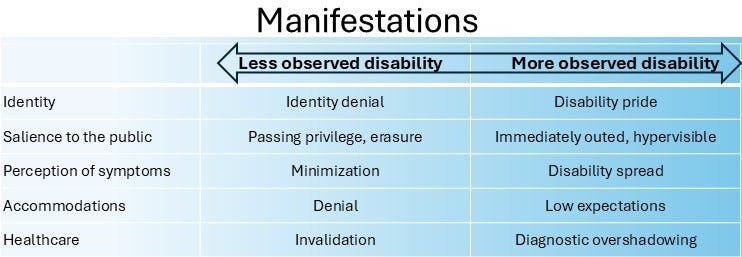
Identity. People on the observable side of the spectrum are more likely to identify as disabled and form a positive disability identity. In contrast, people on the other end of the spectrum may internalize the invalidation they experience, believing that they don’t “count” as disabled. This could be a missed opportunity; positive disability identity is associated with social support, advocacy, and recognition of one’s rights.
Salience to the public. People whose disabilities are less observed experience civil inattention—the privacy afforded to non-stigmatized people in public spaces—and “passing privilege.” Yet, this can feel like erasure of a part of one’s experience or identity. In contrast, those who disabilities are observed are hypervisible—they will be recognized and remembered in public.
Perception of symptoms. Those with more observable disabilities may experience disability spread, a bias where people wrongly assume a disability impacts more domains than it actually does. When people assume that a person who uses a wheelchair also has intellectual disability, that’s disability spread. Oscar-winning Deaf actress Marlee Matlin has a story about how she was once recognized on a flight by the flight attendants, and they “helpfully” gave her a braille menu. On the non-observable end of the spectrum, others may minimize symptoms and their impact.
Accommodations: Access to accommodations in the workplace or school may also diverge according to the extent to which the disability is observed. Those whose disabilities are not observed may be denied accommodations, are expected to provide a higher burden of proof, and when accommodations are given, they may be insufficient. Those whose disabilities are observed may experience paternalism in the form of low expectations or overprotection.
Healthcare: People on the less observed end of the spectrum frequently face invalidation in medical settings. For many of these disabilities, medical tests or biomarkers are not available. They may be subconsciously threatening to healthcare providers because they are more difficult to assess and treat with the tools provided in their medical training. On the other end of the spectrum, diagnostic overshadowing—when a healthcare provider wrongly attributes symptoms to an existing disability rather than investigating other causes—occurs for people whose disabilities are observed.
By moving beyond the binary, we can start to address the specific ways ableism manifests in daily life. Paternalism and delegitimization are different ableism pathways rooted in the same observability spectrum. Recognizing this spectrum is the first step toward creating research, policies, and environments that respond to our needs with respect and legitimacy, rather than pity or suspicion.
A version of this post also appears on Psychology Today.
The language used around describing disability is important. You've obviously spent a lot of time wrangling with this. Much appreciated.
Thanks for this analysis! FND occupies unique positions on these spectra. Disabilities can be very mild to severe, visible or invisible, and are notoriously changeable over time. However, FND is invisible on diagnostic tests, other than a few which seem to confirm its status as a "not real" condition (e.g., distractibility). Therefore, patients with visible symptoms are subject to overt suspicion and delegitimization at the doctors' office. Some doctors even tell the parents of FND patients not to show them support, as it validates their imagined symptoms.